







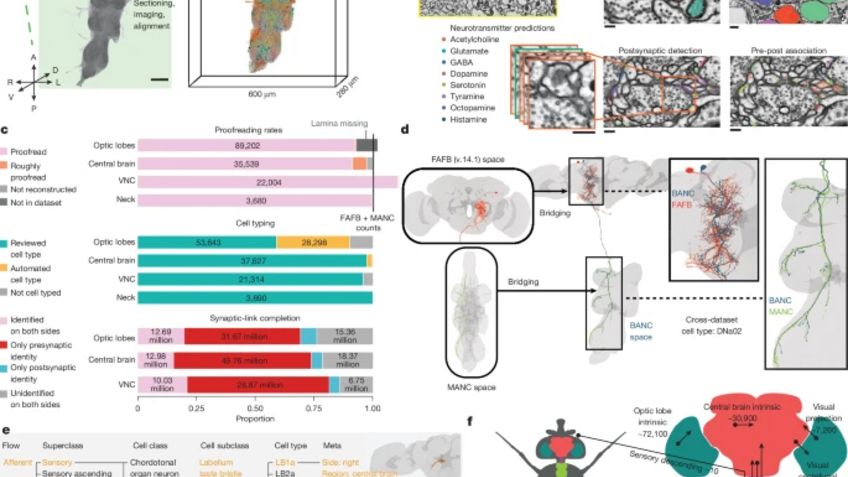


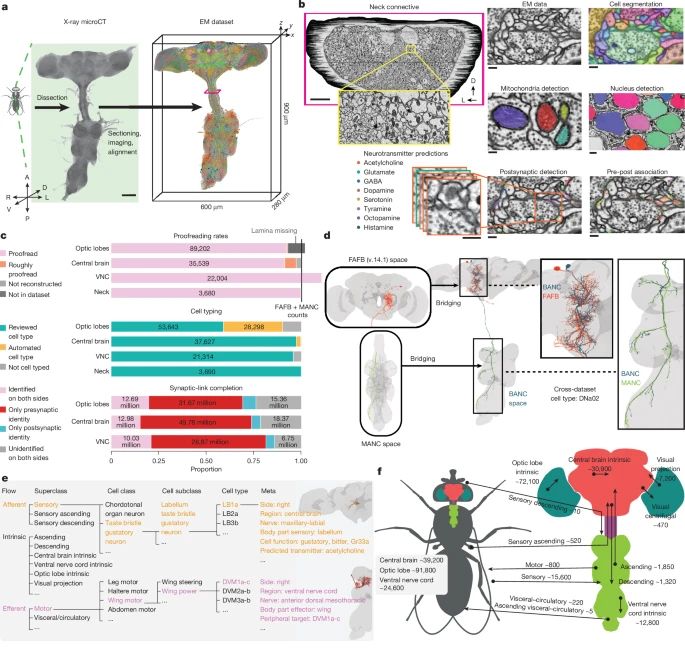
Two years after the publication of the complete connectome of the adult Drosophila melanogaster brain, another major step towards understanding how the nervous system computes inputs and generates behavior has been made. While the previous FlyWire connectome mapped approximately 130,000 neurons of the brain, the newly published Brain and Nerve Cord Connectome (BANC) extends this approach to the entire central nervous system by combining the brain and ventral nerve cord (VNC) in a single connected volume.
The VNC, homologous to the vertebrate spinal cord, contains many of the circuits controlling movement and processing sensory information from the body. The BANC connectome contains around 40 million synaptic connections and makes it possible to follow neuronal pathways from sensory inputs through the central nervous system to motor, endocrine and visceral outputs. Analysis of this network revealed that much of the control of the body is organized in local circuits, which are connected to each other and to the brain through ascending and descending interneurons.
The Pankratz lab again contributed its expertise in the neuroendocrine circuits of the Drosophila larva to the project, identifying key endocrine neurons and, for the first time, all 20 Hugin neurons in an adult fly EM volume. The group also identified a set of key sensory neurons involved in maintaining the animal's internal state, which they had previously characterized in the larva (Miroschnikow et al., 2026, bioRxiv).
Together with the previously published FlyWire connectome, the subsequently published male CNS dataset, and available connectomes of the Drosophila larva, BANC now provides new opportunities to compare neurons and their connectivity across datasets and developmental stages. Damian Demarest and Prof. Michael J. Pankratz are co-authors of the study, which has now been published in Nature.
Publication:
Distributed control circuits across a brain-and-cord connectome.
Bates AS, Phelps JS, Kim M, Yang HH, Matsliah A, Ajabi Z, Perlman E, Delgado KM, Osman MAM, Salmon CK, Gager J, Silverman B, Renauld S, Salman F, Patel J, Collie MF, Fan J, Pacheco DA, Zhao Y, Zhang W, Serratosa Capdevila L, Roberts RJV, Munnelly EJ, Griggs N, Langley H, Moya-Llamas B, Zhang Z, Maloney RT, Yu SC, Sterling AR, Sorek M, Kruk K, Serafetinidis N, Dhawan S, Klemm F, Brooks P, Lesser E, Jones JM, Pierce-Lundgren SE, Lee SY, Luo Y, Cook AP, McKim TH, Giakoumas DS, Gorko B, Ellis-Joyce J, Zhang J, Kophs EC, Falt T, Negron-Morales AM, Burke A, Hebditch J, Willie KP, Willie R, Popovych S, Kemnitz N, Ih D, Lee K, Lu R, Halageri A, Bae JA, Jourdan B, Schwartzman G, Demarest DD, Behnke E, Bland D, Kristiansen A, Skelton J, Stocks T, Garner D, Hernandez A, Kumar S; BANC-FlyWire Consortium; Daly KC, Dorkenwald S, Collman F, Suver MP, Fenk LM, Pankratz MJ, Yao Z, Wang F, Huston SJ, Stürner T, Jefferis GSXE, Eichler K, Seeds AM, Hampel S, Agrawal S, Okubo TS, Zandawala M, Macrina T, Adjavon DY, Funke J, Tuthill JC, Azevedo A, Seung HS, de Bivort BL, Murthy M, Drugowitsch J, Wilson RI, Lee WA.Nature. 2026 Jun 8. doi: 10.1038/s41586-026-10735-w. Online ahead of print.PMID: 42259917
https://www.nature.com/articles/s41586-026-10735-w
Contact
Prof. Dr. Michael Pankratz
Universität Bonn
Life & Medical Sciences Institute (LIMES)
Molekulare Hirnphysiologie & Verhaltensforschung
e-mail: pankratz@uni-bonn.de